
4 أشهر

Workers are training AI and robots to replace them. It could end badly
السبت، 9 مايو 2026
In a factory in Bangalore, workers sit at sewing machines with cameras strapped to their heads. On the other side of the world, workers in a Californian office carry out their jobs under the constant surveillance of software that tracks every click, keystroke and mouse movement that they make at their computers.
Both sets of workers are part of new initiatives to train AI systems to perform human jobs – their jobs – with the hope that machines can one day replace them.
The office workers are Meta employees, and not all of them are happy about it. Some have described the situation as “dystopian”, particularly at a time of heavy job losses for the Facebook and Instagram owner. The man behind it all, Mark Zuckerberg, is reportedly even working on developing an AI agent that can perform some of his CEO duties autonomously.
Meta’s chief technology officer, Andrew Bosworth, claims it is about making the company operate more efficiently, though the company’s global reach and influence could see it impact people around the world.
“The vision we are building towards is one where our agents primarily do the work and our role is to direct, review and help them improve,” he told employees in a memo this month, adding that even the limited role of humans in this setup is designed to be phased out.
The aim, he said, was for the AI agents to “automatically see where we felt the need to intervene so they can be better next time.”
This scenario is only missing a canine companion to meet the dystopian prediction from the US academic Warren Bennis, made in the 1990s, that the factory of the future will only have two employees: “A man and a dog. The man will be there to feed the dog. The dog will be there to keep the man from touching the equipment.”
A report from the International Monetary Fund (IMF) earlier this year found that nearly 40 per cent of global jobs are already exposed to AI-driven change. The report’s authors called for policymakers to make sure that economic gains from AI are broadly shared and not just concentrated in the hands of corporations.
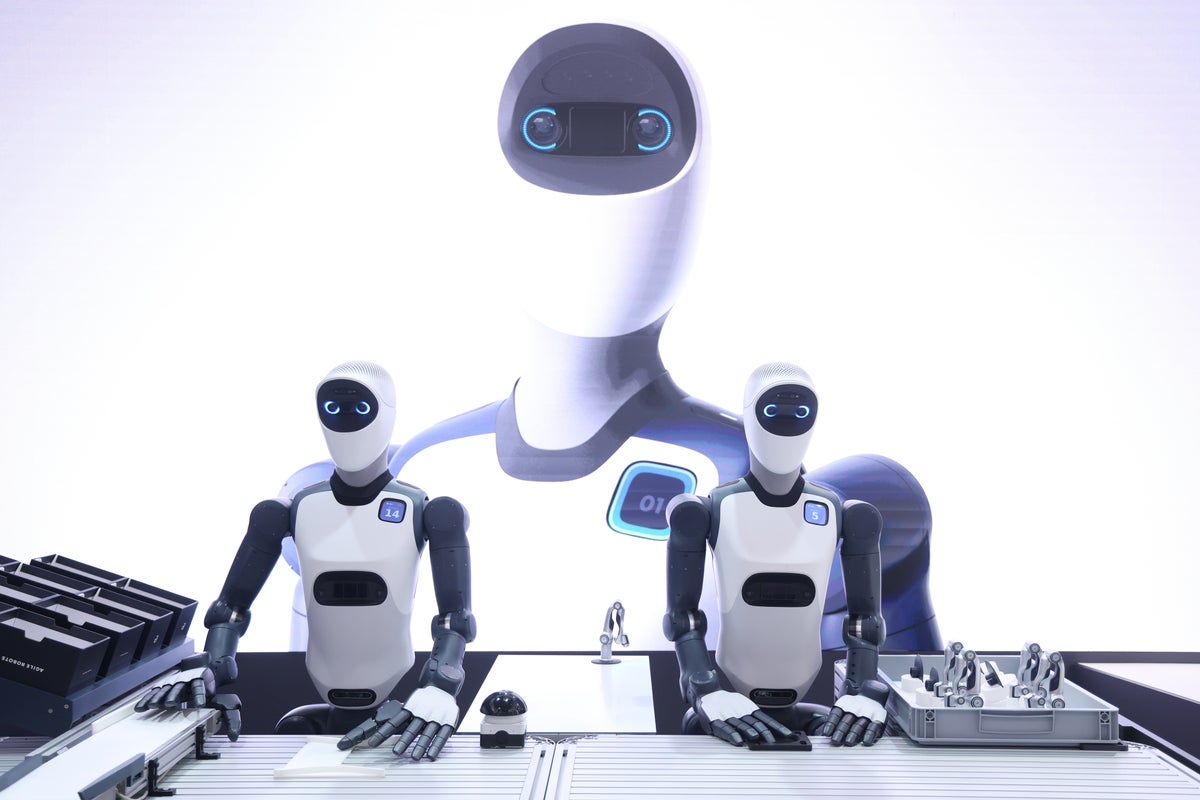
This job displacement trend could worsen with the mass deployment of humanoid robots into the workforce, each versatile enough to perform roles that were once exclusively the domain of humans – from operating sewing machines, to working on building sites.
A poll commissioned by the Trades Union Congress last year found that nearly two-thirds of young adults fear losing their jobs to AI. The union body warned that AI could repeat the “disaster and long-running ramifications of deindustrialisation”, and could see Britain “sleepwalk” into a labour market overrun by AI.
The TUC’s assistant general secretary, Kate Bell, said at the time: “Left unmanaged and in the wrong hands, the AI revolution could entrench rampant inequality as jobs are degraded or displaced, and shareholders get richer.”
It is a thought echoed by David Sherman, head of brand strategy at the decentralised GPU network io.net, in the wake of Meta deploying employee monitoring tools to train AI systems.
“When a handful of corporations control AI infrastructure, they set the terms and everyone else absorbs the cost,” he tells The Independent. “They will ratchet your energy bills, train AI on your work to replace you, then act as though the job losses are an inevitability rather than a choice they made.”
It’s not just workers training AI – billions of people have been teaching machines without even realising it for years. Earlier this year, the creator of Pokemon Go partnered with a robot delivery firm to provide a decade’s worth of crowd-sourced data from players of the augmented reality game.
The database of more than 30 billion images has been used to create a visual positioning system (VPS) that is able to pinpoint a location to within a few centimetres without relying on GPS satellites. It gives autonomous delivery robots unrivalled navigation that allows them to traverse areas that traditional mapping technologies don’t reach, like inside buildings or on park trails.
CAPTCHA systems have been training AI for even longer. Every time a web user identifies a traffic light or bicycle within a grid of images to prove that they are human, they are unwittingly helping to pilot Google’s Waymo robotaxis. Deciphering squiggly text has helped in the digitisation of archived texts and newspapers, while each puzzle piece dragged across a screen is now providing key data for behavioural AI.
By some estimations, Google’s CAPTCHA tests have provided more than 800 million hours of unpaid labour in what is surely one of the greatest heists in tech history.
The training trend has raised concerns among industry experts, with some questioning the legality and morality of the actions of tech firms.
Virginia Doellgast, a professor of employee relations and dispute resolution at Cornell University in the US claims that the data harvesting could be illegal in some countries. “Workers are producing additional value for their employers,” she tells The Independent. “Are they being compensated for this, and are they given a choice to opt in or opt out? Probably not.”
Ruchi Gupta, the executive director of the Future of India Foundation, described the camera-clad workers in the Bangalore factory as a demonstration of “the lopsided balance of power between capital and labour”, which is particularly evident in developing countries like India.
“The workers have no ability to refuse to wear the cameras which are training systems that will eventually replace workers themselves,” she wrote in a series of posts to X. “In a populous and poor country like India, the interests of capital and labour are almost never aligned.”
Nothing here is really new. Humans have been working themselves out of a job for millennia, ever since we invented wheeled wagons to transport goods or taught oxen to pull ploughs more effectively than any human ever could.
Loading ads...
Historically, this has freed humans to come up with new jobs, driving forward technological progress. But this time could be different. With the advent of artificial general intelligence (AGI) – or human-level AI – the tools replacing us might soon be better placed to come up with the new jobs. And also better equipped to do them.
لقراءة المقال بالكامل، يرجى الضغط على زر "إقرأ على الموقع الرسمي" أدناه
اقرأ أيضاً